
- Your cart is empty
- Continue Shopping
Uncategorised
Why Woolworths Uses Rotisserie Ovens When a Much Better Alternative Product Exists
-
By Khabo
- Posted on
- 0 comments
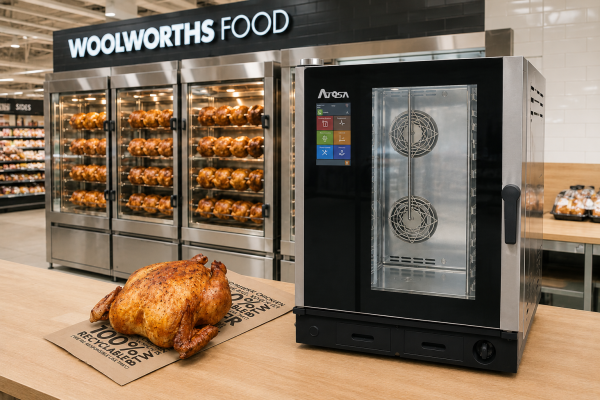
If you have ever walked into a Woolworths store around lunchtime, you have probably noticed the smell of freshly roasted chicken and seen rows of chickens slowly turning inside a rotisserie oven. A rotisserie oven is a machine that cooks food by rotating it slowly while it roasts, helping it cook evenly and develop the golden-brown finish that many people associate with a quality roast chicken.
Another type of commercial oven that has become increasingly popular in professional kitchens is the combi oven. A combi oven combines steam and hot air in a single machine, allowing it to roast, bake, steam, reheat and hold food. Because it can perform multiple cooking functions, many restaurants, hotels and catering businesses now rely on combi ovens as one of the most important pieces of equipment in their kitchens.
This raises an interesting question: if combi ovens are so versatile, why do supermarkets such as Woolworths continue to use rotisserie ovens for their famous roast chickens?
Why Woolworths Uses Rotisserie Ovens
The biggest advantage of a rotisserie oven is not necessarily the cooking itself — it is the experience.
People enjoy seeing chickens slowly turning behind a glass window. The sight, smell and appearance of freshly roasted chickens help create the impression of food that has just been prepared. Even shoppers who did not plan to buy a chicken may decide to take one home after walking past the display.
Rotisserie ovens are also designed specifically for roasting chickens. The constant rotation allows juices to move around the bird during cooking while creating an attractive golden-brown skin. For supermarkets, presentation is often just as important as the final product.
The Limitations of Rotisserie Ovens
While rotisserie ovens are excellent for roasting chickens, they are relatively limited in what else they can do.
A supermarket kitchen often needs to prepare vegetables, baked goods, ready meals, side dishes and other hot foods throughout the day. In many cases, separate pieces of equipment are needed for these different tasks.
This means businesses may need more equipment, more floor space and more time spent moving products between machines.
Why Combi Ovens Have Become So Popular
Modern combi ovens are designed to handle a wide variety of cooking tasks in a single unit.
Using steam, humidity, convection heat or a combination of both, they can:
- Roast chickens
- Grill meat
- Bake bread and pastries
- Steam vegetables
- Cook rice and potatoes
- Reheat prepared meals
- Hold food at serving temperature
- Cook multiple products at the same time
One of the biggest advantages is humidity control. By automatically controlling moisture levels inside the cooking chamber, a combi oven can help food stay juicy while still developing colour and texture on the outside.
For businesses preparing large quantities of food every day, this consistency can make a significant difference.
The Importance of the Core Temperature Probe
One feature found on some modern combi ovens is a core temperature probe.
Instead of relying only on cooking times, the probe is inserted into the centre of the food and measures its internal temperature as it cooks.
This means the oven can continue cooking until the exact target temperature is reached rather than simply running for a set amount of time.
The result is more consistent food quality, improved food safety and less risk of overcooking. Whether cooking a single chicken or preparing large batches, the final product is far more predictable.
A Modern Alternative: The Atosa 10 Pan Combi Oven
One example of a modern combi oven is the Atosa 10 Pan Smart Touch Combi Oven.
Designed for commercial kitchens, it combines steam, convection and combination cooking modes in a single machine. The oven features a large 10-inch touchscreen, programmable multi-stage cooking, automatic humidity control, eight variable fan speeds with reverse rotation, rack timing for mixed loads and a built-in core temperature probe. It also includes automatic cleaning programmes, USB recipe storage and a triple-pane glass door designed for durability and energy efficiency.
One particularly useful feature is the core probe cooking function. Staff can insert the probe into the product, set the desired internal temperature and allow the oven to monitor the cooking process automatically. This helps deliver consistent results while reducing the need for constant supervision.
For businesses that prepare a wide range of foods throughout the day, this level of flexibility can offer significant operational advantages over equipment designed for a single purpose.
Conclusion
There is a good reason Woolworths continues to use rotisserie ovens. They create an experience that customers enjoy, and they produce visually appealing roast chickens that have become part of the supermarket’s identity.
However, when versatility, efficiency, consistency and kitchen productivity are considered, modern combi ovens offer compelling advantages. While rotisserie ovens remain excellent for displaying and roasting chickens, businesses looking for a more flexible solution may find that a modern combi oven provides far greater value across a much wider range of cooking applications.
Shop The Atosa Combi Steamer: https://wedoall.co.za/product/atosa-10-pan-combi-steamer-epc-1011e2/?srsltid=AfmBOoqLAMrMum2howI7u14d8iIABrELkYzvYokt04Nhf2966SJUHHIo
Shop WEDOALL’s Combi Ovens: https://wedoall.co.za/product-category/heating-equipment/ovens/combi-steam-ovens/
Shop WEDOALL’s Rotisseries: https://wedoall.co.za/product-category/rotisseries/
Rotisserie Oven vs Combi Oven: Quick Comparison
